APPLICATIONS NOW OPEN !
We are currently recruiting students in 9-11th grade for our 12-week Ocean Literacy Course that will start in February 2026. This UCSD course will be taught by Scripps Institution of Oceanography graduate students.
Program Highlights:
- Live Virtual Workshops: Weekly 90-minute sessions that combine content learning, small group discussions, and hands-on exploration using ArcGIS. Students will build technical skills in geographic information systems while analyzing real-world ocean and climate data.
- Saturday In-Person Workshops: Hands-on learning in natural spaces—like Kendall-Frost Marsh—and world-class research facilities, including the Scripps Institution of Oceanography and Birch Aquarium. Students will learn directly from SIO scientists, tour research labs, and engage with cutting-edge marine and climate science. Transportation provided to and from program sites via designated community pick up locations.
- Pre-College Credit: Complete the 12-week course + 4 in-person Saturday workshops to earn 4 pre-college credits and certification of completion.
Students who complete Phase 1 will be eligible to apply for Phase 2, which offers opportunities to earn a PADI Scuba Diving License or participate in Naturalist Training, and Phase 3, a paid fellowship opportunity to build technical skills, receive workforce training, and work alongside career mentors. Through this program, students will grow as conservation leaders by designing and implementing community-based conservation projects that create real impact.
OCEAN LITERACY FRAMEWORK
CLP’s Ocean Literacy Curricula is developed by leading curriculum designers and practitioners using key essential principles established by the National Marine Educators Practitioners Guide (NMEPG), created by the National Marine Educators Association (NMEA) with support from NOAA, and the Understanding Global Change framework, developed by the University of California, Berkeley, Museum of Paleontology to help students make connections between how Earth systems work, the causes of global change, and measurable environmental changes. All modules are paired with in-person Saturday workshops that reinforce concepts learned through place-based engagement and community work, while also providing opportunities for students to meet and learn from leading scientists at UCSD.
What is Ocean Literacy?
Ocean Literacy is… “an understanding of the ocean’s influence on you – and your influence on the ocean. An ocean-literate person understands the essential principles and fundamental concepts about the functioning of the ocean; can communicate about the ocean in a meaningful way; and is able to make informed and responsible decisions regarding the ocean and its resources.” (NOAA)
To be ocean literate is not simply knowing everything there is to know about the ocean, but rather understanding the fundamental aspects of our relationship with the ocean and using that knowledge to guide our decisions and actions. Communication is also an important aspect of ocean literacy, just like it is an important skill in being a successful conservation leader.
How do we incorporate it into our program?
Phase 1 of the Conservation Leadership Program is grounded in the ocean literacy framework. The National Marine Educators Practitioners Guide (2021) was a guiding resource for curriculum development, focusing on the major standards and concepts within each Essential Principle.
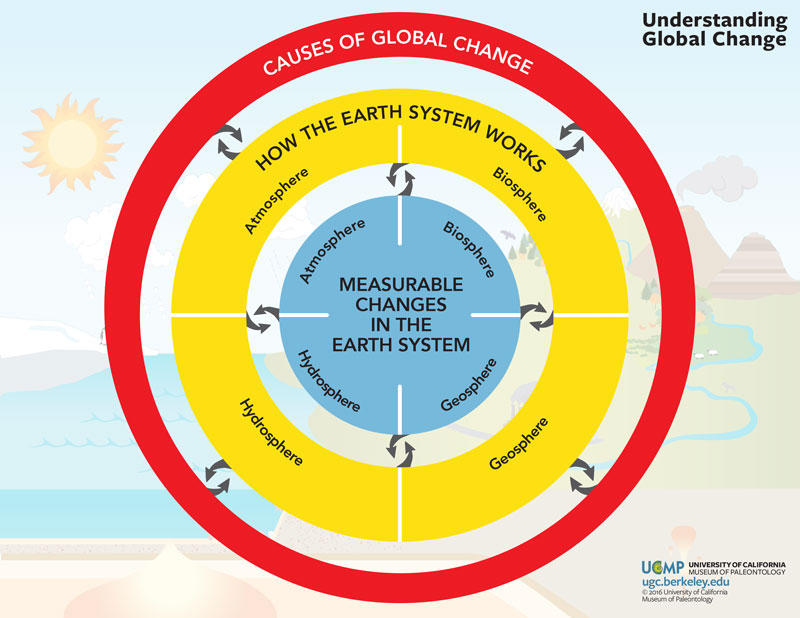
The Understanding Global Change (UGC) framework, developed by UC Berkeley and the UC Museum of Paleontology, is a modeling tool designed to explore the interactions between human and natural processes and their environmental impacts. The three key components of the UGC framework are causes of global change, how the Earth’s system works, and measurable changes. This online tool allows students and instructors to create flow diagrams that visualize and explain complex global processes affecting local and global systems.
As part of the Conservation Leadership Program, students will use the UGC platform to develop models that reflect their understanding of weekly topics. Topics include ocean circulation, carbon cycling, food web interactions, ecosystem services, and human health, among others. Through this process, students will strengthen their ability to interpret Earth system models and effectively communicate complex environmental issues—both essential skills for future conservation leaders.
In this course, students will develop technical skills in ArcGIS, becoming well-versed in mapping, spatial analysis, and data visualization. Through hands-on projects, they will learn to apply these skills to real-world ocean and climate datasets, building both technical expertise and an understanding of how geographic information can inform conservation and environmental decision-making.

Community Conversations are an important component of our curricula. It involves students engaging with local community members to discuss various topics related to ocean literacy covered in the course. Students are encouraged to reflect on these conversations, exploring how the community views and connects with ocean-related issues such as marine conservation, climate change, and sustainable practices. These reflections help students understand different perspectives, strengthen their communication skills, and deepen their connection to the broader societal impact of marine science.
SATURDAY WORKSHOP GUEST SPEAKERS
Thank you to our 2025 partners!
Week 1 - Macroscale Processes
Macroscale processes in the ocean refer to large-scale movements and patterns of ocean currents driven by Earth’s rotation, wind patterns, and temperature differences across latitudes. These processes include the movement of surface waters, the deeper ocean currents, and the global ocean conveyor belt, all of which play crucial roles in regulating climate, distributing heat, and transporting nutrients that sustain marine life. They form the foundation for understanding how Earth’s rotation drives winds and currents, how circulation patterns vary with depth, and how physical processes shape biological systems. Students will also learn directly from Dr. Ralph Keeling, Dr. Jeramy L. Dedrick, and Christian Pelayo at SIO, who bring their expertise in climate science and oceanography to exploring these large-scale ocean dynamics.
Dr. Ralph Keeling
Ralph Keeling, whose work continues the legacy of the Keeling Curve, is the current program director of the Scripps CO₂ Program. He is also a Professor and the Principal Investigator for the Atmospheric Oxygen Research Group at SIO.
Dr. Jeramy L Dedrick
Jeramy just got his PhD from the Russell Lab and research centers on the complex interactions of small particles (aerosols) produced by manmade and natural processes that form and alter the characteristics of clouds as well as their implications in a warming global climate.
Christian Pelayo
Christian is a PhD Student in the Russell Lab. Currently, Christian is interested in the use of satellite remote sensing data to tease out the effects of aerosol on cloud microphysical properties and lifetime and ultimately their impact on climate.
Week 2 - Ocean Productivity
Ocean productivity refers to the rate at which producers, such as phytoplankton, create organic matter through photosynthesis. This productivity is strongly influenced by the cycling of key nutrients, including phosphorus, nitrogen, and carbon, each of which has distinct sources, sinks, and pathways, though some overlap exists. Phosphates, nitrates, and carbon are all essential for sustaining primary production, and their cycles are shaped by both natural processes and human activities. Understanding how human actions—like agriculture, fossil fuel use, and pollution—alter nutrient availability is critical for maintaining healthy and productive oceans. Students will also learn from Dr. Adi Khen and Kalani Ortiz at SIO, both members of the Smith Lab, who bring their expertise in nutrient cycling and ocean productivity to the course.
Dr. Adi Khen
Adi is curating, cataloguing and digitizing Scripps’ herbarium (i.e., pressed seaweed) collection. She completed her PhD studying coral reef ecology in the Smith Lab, where she used image analysis to track the long-term responses of corals and algae to heat stress. Adi helps teach Phycology (Marine Plant Biology) at UCSD, has interned with The Nature Conservancy’s Hawaiʻi and Palmyra Program, and is involved in the Tribal Intertidal Digital Ecological Surveys (TIDES) project.
Kalani Ortiz
As a staff researcher in the Smith Lab, Kalani’s work involves establishing and maintaining native seaweed cultures in the lab’s outdoor research facility, the “Slab Lab.” Her work also supports ongoing research projects focused on identifying and cataloging seaweed species from the San Diego coastal region, as well as contributing to culinary-focused seaweed initiatives. Outside of the lab, Kalani enjoys cooking, tidepooling and hiking.
Week 3 - Food Web Dynamics
Food web dynamics in the ocean reflect the complex interactions between organisms, from primary producers like phytoplankton to top predators such as large fish and marine mammals. These interactions are fueled by nutrients like nitrogen, phosphorus, and carbon, linking the cycling of matter and energy to ecosystem productivity and stability. Zooplankton feed on phytoplankton and other small organisms, supporting higher trophic levels and illustrating how nutrient availability underpins both ecological health and the marine food web. Human activities can disrupt these dynamics, impacting biodiversity, food security, and local fisheries that provide income, jobs, and sustenance for coastal communities. Students will also have the opportunity to meet and talk with Nicole Glawson, a fisherwoman; Norm Abell, who runs The Flupsy; and Marcus Twilegar, an influential chef at the Tuna Dockside Market, to gain firsthand perspectives on how people depend on and interact with these marine food webs.
Nicole Glawson
John and Nicole Glawson fishes off their boat the F/V Nicole Ann and primarily catch Crab, Lobster, Sheepshead, and Rockfish. Nicole and her husband John can be found on most Saturdays at the dockside market.
Norm Abell
Acacia Pacific Aquaculture is in the business of aquaculture development and project management. Founding principals Norm Abell and Rebecca Richards have 10 years marine aquaculture experience in aquafarm ownership growing culinary and restorative shellfish and seaweed and marine aquaria live-feed, along with over 25 years experience in all aspects of business development.
Marcus Twilegar
Marcus is a San Diego Native who grew up in the South Bay. His father and uncles worked in restaurants, so Marcus was no stranger to the kitchen. Marcus recently opened his first restaurant, Adobo House, where he serves up Filipino food. He is working to slowly introduce fish to the menu in hopes to bring more local fish to a neighborhood that does not really have it readily available in other restaurants.
Week 4 - Ocean Biodiversity
Biodiversity refers to the variety of life in all its forms, from the genetic diversity within species to the diversity of ecosystems. In coastal ecosystems like salt marshes, kelp forests, and seagrasses, biodiversity plays a crucial role in maintaining ecosystem health, resilience, and productivity. These habitats support a wide array of species, from tiny invertebrates to larger marine animals, each contributing to the balance and functioning of the ecosystem. Coastal and ocean systems are closely connected to the land, with terrestrial activities influencing water quality, nutrient flows, and overall marine health. Understanding these systems is especially important as human activities and climate change continue to threaten marine biodiversity worldwide. Students will also have the opportunity to visit the Marine Vertebrate Collection at SIO with Dr. Fernando Melendez Vazquez and explore the Birch Aquarium, with thanks to Dr. Nan Renner for providing access and supporting programming, gaining hands-on experiences that connect biodiversity concepts to real-world marine life.
Dr. Fernando Melendez Vazquez
Fernando Melendez Vazquez, a recent PhD graduate in marine biology at Scripps Oceanography studies the evolution of unique traits across the fish tree of life. Driven by a lifelong passion for the natural world, especially shaped by his childhood in Puerto Rico, Fernando is not only advancing fish evolutionary research but also engaging in science outreach, sharing his love for marine biology with the public through tours and social media videos.
Dr. Nan Renner
Nan facilitates university and community partnerships to engage public audiences with Scripps Oceanography science and to advance Birch Aquarium’s mission. Focused efforts include climate change, environmental justice, integration of western science with Indigenous ecological knowledge, and collaboration on teacher professional development, public programs, and exhibits.
Birch Aquarium
Birch Aquarium at Scripps is the public exploration center for Scripps Institution of Oceanography at UC San Diego. Perched on a bluff overlooking the Pacific Ocean, Birch Aquarium features the groundbreaking work of Scripps Oceanography and UC San Diego scientists as well as conservation breeding programs and interactive exhibits. Birch Aquarium’s mission is to connect understanding to protecting our ocean planet, which it achieves through engaging hands-on learning opportunities for more than 500,000 guests and 40,000-plus pre-K-12 students each year.
Week 5 - The Ocean and Human Health
The ocean is vital to human health, producing oxygen, regulating climate, and providing food, medicine, and other essential resources. Healthy marine ecosystems support our well-being by sustaining fisheries, purifying water, and buffering communities against storms and climate impacts. Human activities threaten ocean life and the communities that rely on it, with local impacts in San Diego including heat waves, wildfires, sea level rise, and storms driven by atmospheric rivers. Protecting marine ecosystems supports both biodiversity and human health, ensuring a resilient future. Students in this course will also engage with local youth leaders at the San Diego Youth4Climate 2025 Summit, exploring regional climate challenges, participating in conservation initiatives, and learning how local actions connect to global ocean health.
Youth4Climate 2025 Summit
Youth4Climate — a youth-led team working to empower youth to become climate leaders working together for an equitable, sustainable, and resilient future! Conservation Leadership Students participated in Youth4Climate 2025 Summit, Voices in the Storm. This event is meant to empower youth voices and show you all that your voice matters. Students talked about topics like environmental justice and participated in interactive discussions and activities.
Week 6 - Marine Protected Areas: People and Perspectives
Marine Protected Areas (MPAs) are one of the most powerful tools we have to safeguard ocean ecosystems and the benefits they provide. Global initiatives like “30×30” call for protecting 30% of the ocean by 2030 to ensure healthy fisheries, biodiversity, and climate resilience. But protection is not just about drawing boundaries on a map—it is about people. Indigenous peoples, local communities, fishers, scientists, policymakers, and other stakeholders all bring essential knowledge and perspectives to decisions about protecting marine places. By centering diverse voices and honoring cultural connections to the sea, we can steward our oceans in ways that are both ecologically effective and socially just. Students in this course will also learn directly from keynote speakers Dr. Octavio Aburto, Catalina López-Sagástegui, and Sahmie Wytewa, gaining insights from their expertise in marine conservation, community engagement, and ocean stewardship.
Dr. Octavio Aburto
Octavio is a marine ecologist, conservation photographer, and Professor at Scripps Institution of Oceanography whose research on mangrove forests and marine reserves has earned international recognition, including the Jean Fort Award, WWF Kathryn Fuller Fellowship, Mexico’s Conservation of Nature prize, and a PEW Marine Fellowship. As a National Geographic Explorer and iLCP photographer, Octavio combines science and imagery to advance global marine conservation, working across the Americas to protect biodiversity, fisheries, and the cultural connections people share with the ocean.
Catalina López-Sagástegui
Catalina López-Sagástegui is a Marine Biologist from the Universidad Autónoma de Baja California Sur (2001) in La Paz, Mexico, and obtained a Masters degree on marine biodiversity and conservation from Scripps Institution of Oceanography (2006). Although her initial interests focused on marine mammal ecology, her focused shifted to understanding how coastal communities adapt to changes in their socio-economic realities when public policies aimed at protecting and managing species are implemented.
Sahmie Wytewa
Sahmie S. Wytewa, MEd, a member of the Hopi Tribe from Misongnovi Village in Second Mesa, Arizona, serves as Tribal Liaison for the Center for Inclusion and Diversity at USD. With a background in educational leadership and previous experience as Policy Specialist–Tribal Liaison with the Arizona Department of Education, she brings expertise in building meaningful partnerships, advancing equity, and supporting community-led efforts in both urban and rural tribal settings.
PROGRAM BLOG

Conservation Leaders – A Bountiful Second Week
Author: Liam Kelly, Student Intern RSMS Introduction The start of the day foreshadowed the rest of the day. Upon entering the classroom, students and instructors,

Building Conservation Leaders: Our First In-Person Workshop
Building Conservation Leaders: Our First In-Person Workshop On February 15, we officially launched the Conservation Leadership Program, bringing together an inspiring group of high school